| |
PSALM 133:1“BEHOLD, HOW GOOD AND HOW PLEASANT IT IS FOR BRETHREN TO DWELL TOGETHER IN UNITY!” (KJV, NKJV, RSV, NASB)
“Look how good and how pleasant it is when brothers live together!” (NET)
“How wonderful and pleasant it is when brothers live together in harmony!” (NLT)
“How good and pleasant it is when God’s people live together in unity!” (NIV)
“See how good and how pleasant it is for brothers to live together in unity!” (YALL)
Unity. This is probably one of the most difficult concepts to achieve in human nature. After all, the sinful nature we are all born with tends to want, more than anything else, to have its own way. Selfishness is common in our species…unity is rare.
As citizens, we would hope our leaders would find a peaceful way to make wise decisions about our lives in a united, wise way. We wish that all human beings could find some way to live with one another without needing to resort to violence to do what is best for everyone. Unfortunately, this image is rarely seen among us and more often, we resort to conflict and even violence to get what we want. Look at how many times nations have waged war against each other.
In contrast, you would think that Christian church would have enjoyed centuries of peace united around the principle of following Jesus and His teachings. History does not teach us that however. There are probably more separate divisions, even in the church, than we might find among the nations. Look at histories of the Crusades, the Inquisition, the Salem Witch Trials and the uncountable religious wars that have divided us throughout the world and throughout history. Our track record of unity in the church isn’t a good one. (Not necessarily a pleasant one either.)
God’s Word in Psalm 133 seems to indicate that unity is both good and pleasant. The term “good” is the same word used to describe God Himself. It is certainly sure that the only real unity that lasts and actually brings us together must come from Him.
Of course, the fact that unity is also pleasant seems obvious. Let the smallest fraction of disunity show itself and anyone can see the un-pleasantness of it. I’m always wary of those who love to disagree. (I hope the testimony and example of my life isn’t making you think of me.)
Look at the nation of Israel. Over a million Israelites had just been rescued from the threat of Egypt by a miraculous parting of the Red Sea…with the promise of a trip to a “promised land,” described as being so good it flowed with milk and honey. Maybe less than a week from their deliverance they moved right into griping, complaining, arguing and fighting over why they shouldn’t go back to Egypt.
Well, after all, life in the desert had to be tough. And imagine the unwanted task Moses had of keeping a million of these people united long enough to get them across that desert to the paradise of promise God made to them. “We are thirsty!” God gave them water IN THE DESERT! “We’re hungry!” God gave them manna…a bread like substance…that literally fell down from heaven. “We want REAL food!” God provided bird meat that miraculously arrived to satisfy their hunger for more.
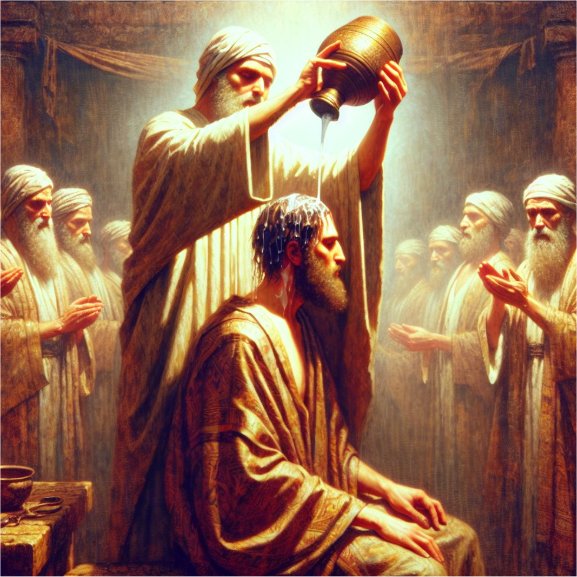
Somewhere, in the trek across the Sinai, God helped Moses by providing helpers to carry the load that Moses could not carry alone. One of those provisions was equipping Aaron, Moses’ brother, with the task of priestly duties for the people of the nation…he was Israel’s first priest. I can only imagine the ceremony where Moses followed God’s instructions, anointed Aaron with oil and watched it not just pour on his head, but down his beard and down the edge of his garments. (See Psalm 133:2)
In Exodus 30:22-33, the LORD told Moses how to mix the holy oil used to consecrate the tabernacle, its furniture, and the priests. According to vs. 30, “You shall anoint Aaron and his sons, and consecrate them, that they may serve me as priests” (ESV). However, no one else was to use it: “It shall not be poured on the body of an ordinary person, and you shall make no other like it in composition” (vs. 32, ESV).
Later, in Numbers 18:1-7, God charges the priests and Levites with their duty. Right in the middle of the charge, listen to what God says: “And you shall keep guard over the sanctuary and over the altar, that there may never again be wrath on the people of Israel” (ESV). The anointed priests did their job, representing all Israel and bearing their names before the Lord in their work at the tabernacle, then temple, in order to preserve all of Israel from wrath. If you read all of Exodus, you will see that Israel provided God with plenty of reasons to display His wrath on them. So, do we.
These anointed, consecrated, specially dressed priests bore the names of Israel, the judgment on Israel, and the guilt of Israel in their work as priests. Their anointing protected all Israel when they fulfilled their role properly.
It is hard to know how Aaron felt about the oil pouring on his head, running down his beard, soaking into his garments. He may have tolerated it because God commanded it. But for Israel, the anointing of Aaron was an incredible picture of unity. One man, anointed, and bearing the entire nation into the very presence of God when he walked into the Holy of Holies.
That unity, predicated on the anointing of a priest and his work in the LORD’s temple is supposed to change the behavior of the people represented by his role. They are to be united not just in Aaron’s representation, but in their daily lives and communities. And their unity is pleasant and good. What’s more, walking together in unity under the headship of God, they would be preserved from wrath.
In previous chapters of this book, you may recall that I said I understand that there are so many denominations in the Christian church. We cannot agree on every doctrine of the Bible the same way. Different churches…at least in our nation…give us some incredible options to worship the Lord every week (every day?) in a way that we can agree is comfortable to us.
What is difficult to understand, however, is how quickly we can insist on worshipping Jesus in OUR way…which is obviously the correct way. We find it easy to argue over who is saved and who is not, what the proper formula for baptism and communion must be, how the Holy Spirit can move in our congregations, who should be our preachers and teachers, and sometimes, over what the color of the carpet should be.
I admit that over the last 2,000 years in the history of the Christian church, there have been a lot of ideas and doctrines that get a lot more credit coming from our imagination than actual Scriptural basis. I know that some errors in the church cannot be tolerated as they are contrary to what the Bible says. Truth must come from the Lord and not necessarily our individual interpretation of Scriptures alone. However, our intolerance for differences that the Lord might find far less objectionable than we do might be the real reason for so many divisions in the church.
In a recent study I did of what the church has considered “heresy” I discovered that, although many of those opinions of what heresy was were truly Scripturally based, a whole lot of the others were made on the basis of what the majority of believers believed. The very definition of the word reveals that it is “religious opinion that is opposed to the doctrines of a church; opinion that is opposed to generally accepted belief.”
When the children of Israel spied out that promised land, two spies declared, “God has promised it to us, it is just as great as He said it was, we must take it!” Ten spies (the majority) declared, “there are giants in the land, taking the land is too hard to do, we trust our fear more than we trust God, let’s get out of here!” The majority won the day, but the nation was anything but united!
I think one of the key aspects to the truth of Psalm 133:1 is hidden in the word “brethren” or “brothers.” I apologize to all you NIV lovers, but its version says, “when God’s people” where the other versions stick with the word “brothers.”
In over seventy years of my life, I have found that “God’s people” always have a hard time maintaining the kind of unity referred to in the verse. God’s people frequently find it easy to disagree (and sometimes fight) over just about everything happening in the church. What is implied by the word “brothers” however, has had far more success.
I shared with you earlier how much my four brothers and I fought each other as we grew up in a pretty large family. We loved each other, because love was demonstrated, taught and expected from us whether we fought like boys do or not. We might have argued and fought along our way…but if someone outside the family tried to attack one of my brothers, I always made sure you had to come through me first (I was the oldest).
My brothers and I disagreed about a lot of things through life, but there was a unity of love we grew up with that will never allow us to deny each other or tear the family apart. I know that not every family is that way. But that does not diminish the idea that we always knew we must love, protect and honor each other…in a way only brothers (and sisters) can.
I grew up in a church environment where my parents insisted that we call those older than us in the church “Brother…” I grew up under the supervision of not only my mom and dad, but also under the example and expectations of Brother Joe, Brother Don, Sister Ruby and Sister Wickman. That term insisted on us respecting older church members and friends, but also implied a special, loving relationship that only comes along with “family.”
I spent many years in an association of ministers and pastors called the Bethel Ministerial Association. I learned from, respected, obeyed and modeled myself after Brother Jim, Brother Etnier, Brother Joe and Brother Badger. Even though he was closer to my age, I loved and respected him enough to call him Brother Steve…I still do, even in my seventies.
There is a unity that is gained by association of the “family” that can’t be gotten by rules, regulations, commands and bylaws. I try to obey the rules I come under. But if Brother Jack told me to walk a certain way, use a certain language, deny lusts and pleasures that weren’t pleasing to the Lord, I would do my best to obey and follow his godly advice. I don’t always agree with the judgment and decisions that come from my “brothers” in the Lord…but we will always remain united in our approach to following Jesus that comes from being brothers. That is good and pleasant.
That kind of unity is good because it comes from our love of Jesus and fellow understanding of His words. That kind of unity is pleasant because it is Christ-centered and founded by our love for each other and our common love for the Lord. Jesus isn’t threatened when we express differences of opinions and occasionally have heated discussions of who is right in this interpretation or that. But when we choose to overlook our differences, get past trying to have our own way on whatever issue seems “hot” at the moment, and move forward together arm in arm for the glory of the kingdom of God, the Lord sees in us a sweetness that reminds Him of the anointing oil that poured down over Aaron…that same anointing that we share together because of the anointing of the Holy Spirit in our lives and our ministries.
How good and how pleasant it is when brothers dwell together in unity!
Questions to consider: What are some doctrines in the Bible that are worth fighting over? Now, what are some issues we have divided over that really should not have cost a loss of unity? How quickly can we lose love over issues among the body of Christ that really should not make that big a difference? Are there some “non-negotiable” doctrines, beliefs or opinions that we must never “give in” on? What are some great examples of unity where differences have also existed?
Other Scriptures to study: 2 Timothy 2:23 “But avoid foolish and ignorant disputes, knowing that they generate strife. And a servant of the Lord must no quarrel but be gentle to all, able to teach, patient.” Proverbs 20:3 “It is honorable for a man to stop striving since any fool can start a quarrel.” Prov 17:14 “The beginning of strife is like releasing water; therefor stop contention before a quarrel starts.” Titus 3:9 “But avoid foolish disputes, genealogies, contentions, and strivings about the law; for they are unprofitable and useless.” Ephesians 4:3 “Endeavoring to keep the unity of the Spirit in the bond of peace.” John 17:22 “…that they may be one just as We are one.” 1 Cor 1:10 “Now I plead with you, brethren…that you all speak the same thing and that there be no divisions.” Phil 2:2 “Fulfill my joy by being like-minded, having the same love, being of one accord, of one mind.”
|
|